Traveling With Kids Without Losing Your Mind
If you've ever stood at airport security holding a squirming toddler, a diaper bag the size of a small car, and a boarding pass you can't quite reach… First, hi, welcome. Second, I promise it gets easier.
I get asked some version of "how do you do it?" almost every time I mention we're traveling with our two kids (6 and 2). And the honest answer is: it's not magic, it's not a secret gadget, and it's definitely not one of those Pinterest-perfect diaper bags with color-coded pouches. It's a mix of preparation, a serious mindset shift, and a packing system I've rebuilt about a hundred times until it finally stopped fighting me. So if you're a mom staring down your first flight with a little one (or your fifth, and still white-knuckling it), this one's for you.
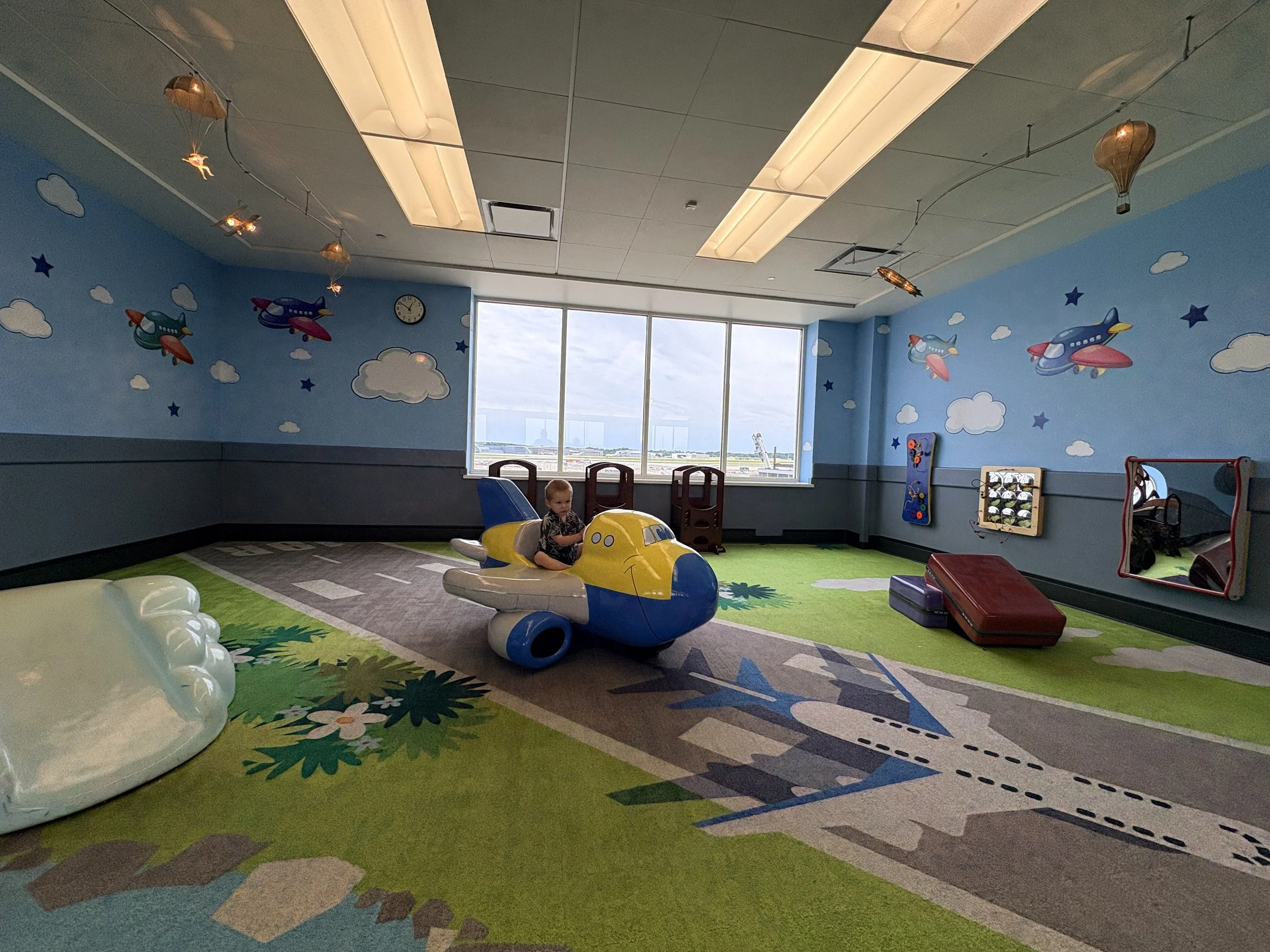
Kids play area at MKE Airport
Understand Travel Logistics First
Here's the thing nobody tells you before your first family flight: it is very unlikely to go exactly as planned. Someone will need a diaper change at the worst possible moment. Your toddler will nap for 20 minutes instead of 2 hours. The iPad will die right when you need it most. The families who seem to "have it together" at the gate aren't the ones with zero hiccups. They're the ones who expected the hiccups and packed a plan B (and a plan C).
So before you even get to the airport, do the boring logistics work so your day-of brain has less to juggle:
Know your airline's baggage allowance. Most major U.S. airlines give each paid passenger a carry-on and a personal item, plus an additional allowance for a diaper bag. That's more real estate than people realize, and it means a family of four can travel with quite a bit while not having to check a bag.
Build in buffer time, but not too much. For a domestic flight with no checked bags, we aim to get to the airport about 1.5–2 hours early. Earlier than that and you’ll lose your mind before boarding even starts.
Decide your "home base" strategy at the gate (more on that below).
Accept, right now, that the plan will change. Delays happen. Gates change. When they do: take a breath, and focus on what you can actually control in that moment.
Being prepared doesn't mean nothing goes wrong. It means when something does go wrong, you're not also scrambling for a diaper, a snack, and a spare shirt at the same time.
The Real Secret: Stop Worrying
Here's my actual hot take, the one I wish someone had told me before our first flight: stop worrying about what the people around you are thinking about your kid.
Everyone in an airport has an opinion about kids in travel spaces. I promise you, almost all of those people are stressed about their own trip, their own connection, their own life — their sighs and side-eyes are not a true reflection on your parenting. Your child belongs in that airport. They belong on that plane. They belong at the attraction you drove two hours to get to.
I'll be honest: after my kids' first few flights, watching my toddler lick the tray table, crawl across the airport floor, and touch every surface that absolutely did not need touching; it still grosses me out. I don't think that feeling ever fully goes away (please, wipe the tray table). But it doesn't freak me out anymore. That shift, from panic to "okay, gross, but fine," is honestly one of the most useful things I can tell a new traveling parent. Let your kid be a kid in these spaces. The rest is just noise.
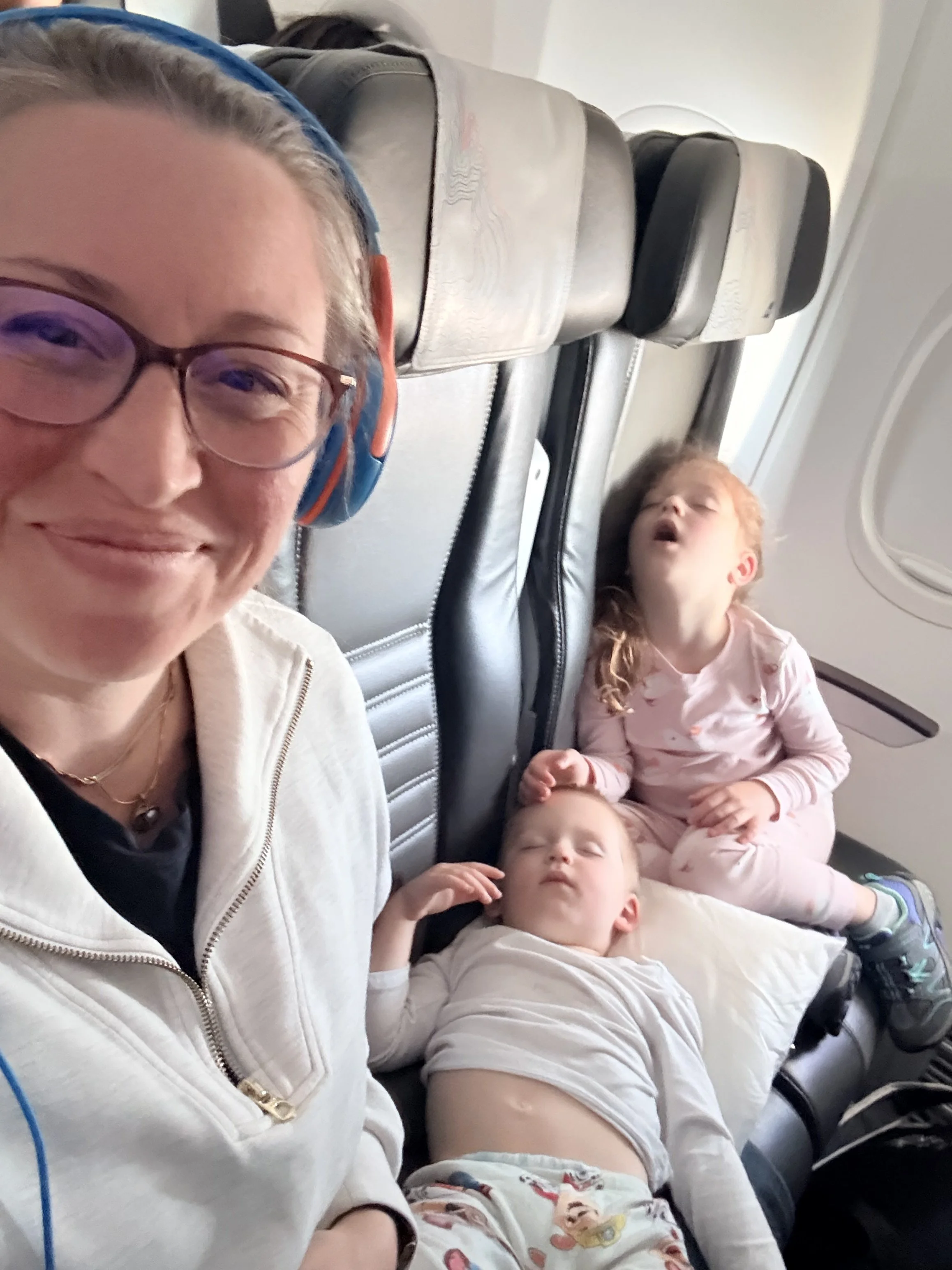
Naps are inconsistent but precious
Packing: My Favorite Part (Now That I've Actually Figured It Out)
I want to save you some money and some suitcase space: skip the tray table covers and the suction-cup toy spinners. The tray table covers only work if you have one child with the coordination and patience of a tiny surgeon who will quietly play with Legos for hours (if you have that child, please tell me your secrets). The suction cup spinners don't stick to anything except the window, and even that's a stretch. They'll entertain your kid for a few spins and then just take up space in your bag for the rest of the trip.
On my first 5-plus flights with my babies, I scoured the internet for toys and gadgets, buying every trinket that promised to keep my kids busy, because I was anxious and convinced these things had to work. They mostly didn't. Here's what I keep packing, flight after flight, because it actually works:
Individual bubble wands (yes, you will find me blowing bubbles in the airport, at restaurants and pretty much everywhere except the actual plane)
Water books (great for every age, no notes)
Wax sticks (I’m pleasantly surprised everytime my kids spend more than 15 minutes quietly smashing these into balls or sticking them to the windows)
All the snacks (now’s not the time to pack things you wish your kids would eat. Pack the oreos, their favorite candy, all the pouches they could want)
iPad or Fire Tablet, loaded with movies or games and fully charged, plus headphones (don’t be that person without headphones…)
That's it. Simple, low-mess, high-payoff.
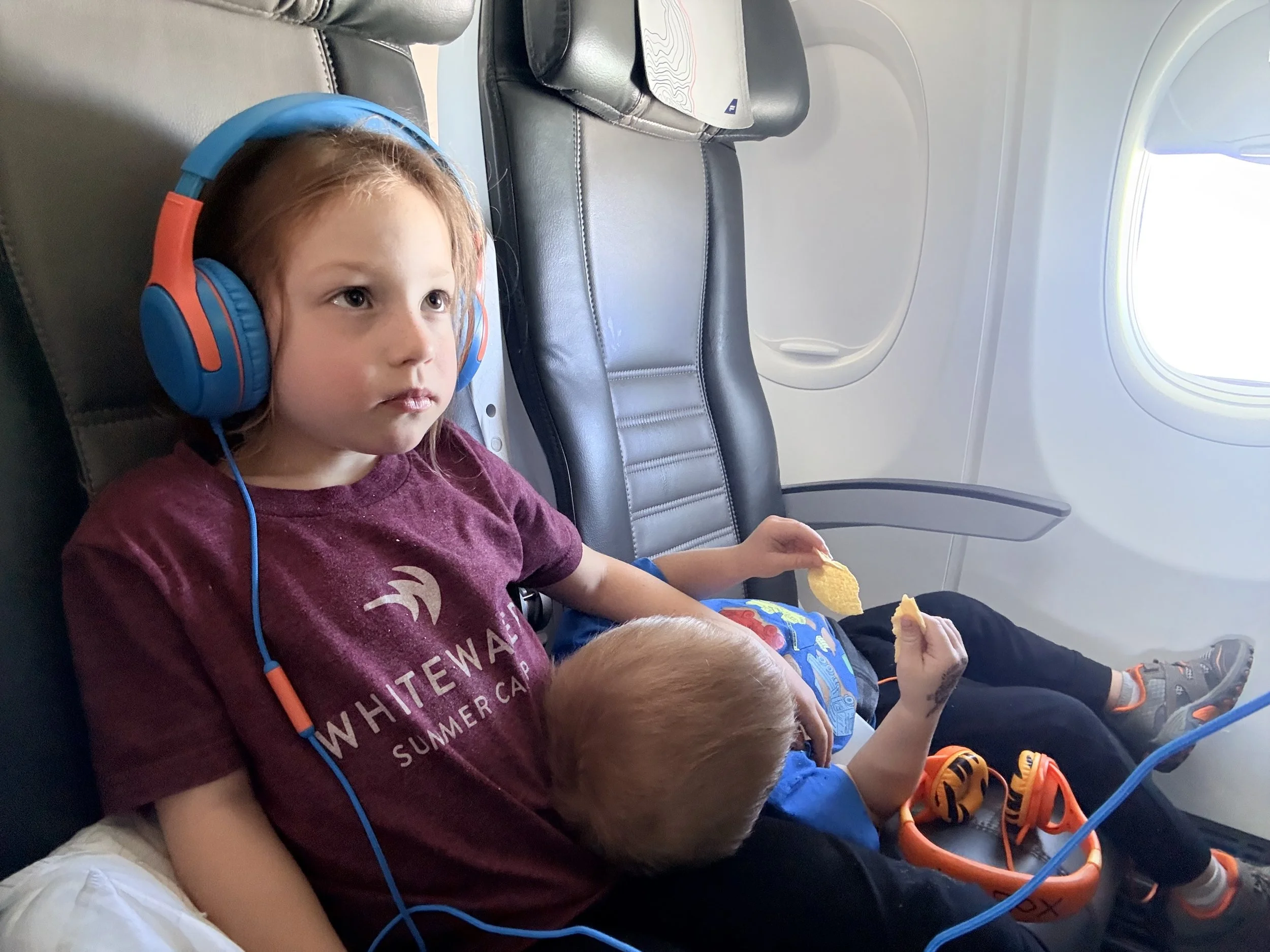
Screen-time is non-negotiable on flights
Our Bag Breakdown: How we actually pack (2 Adults, 2 Kids, Domestic Flights)
We never check bags, mostly because the idea of standing at baggage claim with two cranky kids for an unknown amount of time sounds like my personal nightmare. Here's exactly how we split things up between our carry-ons, personal items, and kid bags:
Each adult's carry-on: Shoes, clothes, and destination necessities. Think blankies, a massive stack of diapers, the sound machine. The bulky stuff that doesn't need to be accessed mid-flight.
My husband's personal item (backpack): All the technology. iPads, laptops, travel screens. These usually need their own bin at security, so keeping them together means less unpacking and repacking chaos. The other thing living in his bag is our toiletry bag: creams, liquids, clippers, bathroom essentials; anything you'll likely need to pull out at security. I keep all of it in one gallon-size ziplock bag so it's a single, easy grab.
My carry-on (a compact crossbody travel bag): This is the "must-haves" bag. Passports, tickets, itineraries, credit cards, battery packs, extra charger, medications. It's small, and it stays on my body from the moment we leave the house until we reach our destination. That way, if we ever need to show documentation, everything's in one place. And if something weird happens ( deboarding, reboarding, an aircraft change) we still have the most important things with us no matter what. I'm known among family and friends for saying: “there's always a Target or Walmart”. Most material things can be replaced. The important stuff stays on me.
Our 6-year-old's kids' travel backpack: In practice, we end up carrying this one most of the time, but it gives her a real sense of responsibility and independence. She has her own bag, just like mom and dad. This is where all the kid fun lives: snacks, toys, games, books, stuffies. I try not to overpack it, because kids will dig through it, pull everything out, and create chaos; and I don't want to spend all my energy shoving things back in before landing.
The diaper bag: My favorite purchase I made for myself when I was pregnant with my second was a Lululemon tote diaper bag that I will defend to the death. This holds a change of clothes for both kids (usually pajamas, since they pack down the smallest), enough diapers for a blowout or an unexpected delay, wipes, empty water bottles (fill them after security), and an extra shirt for both mom and dad; because you will get spilled on, spit on, or pooped on at some point.
That adds up to three bags under the seats, two in the overhead bin, and one that never leaves my body. It sounds like a lot written out, but it's a system now, and it works.
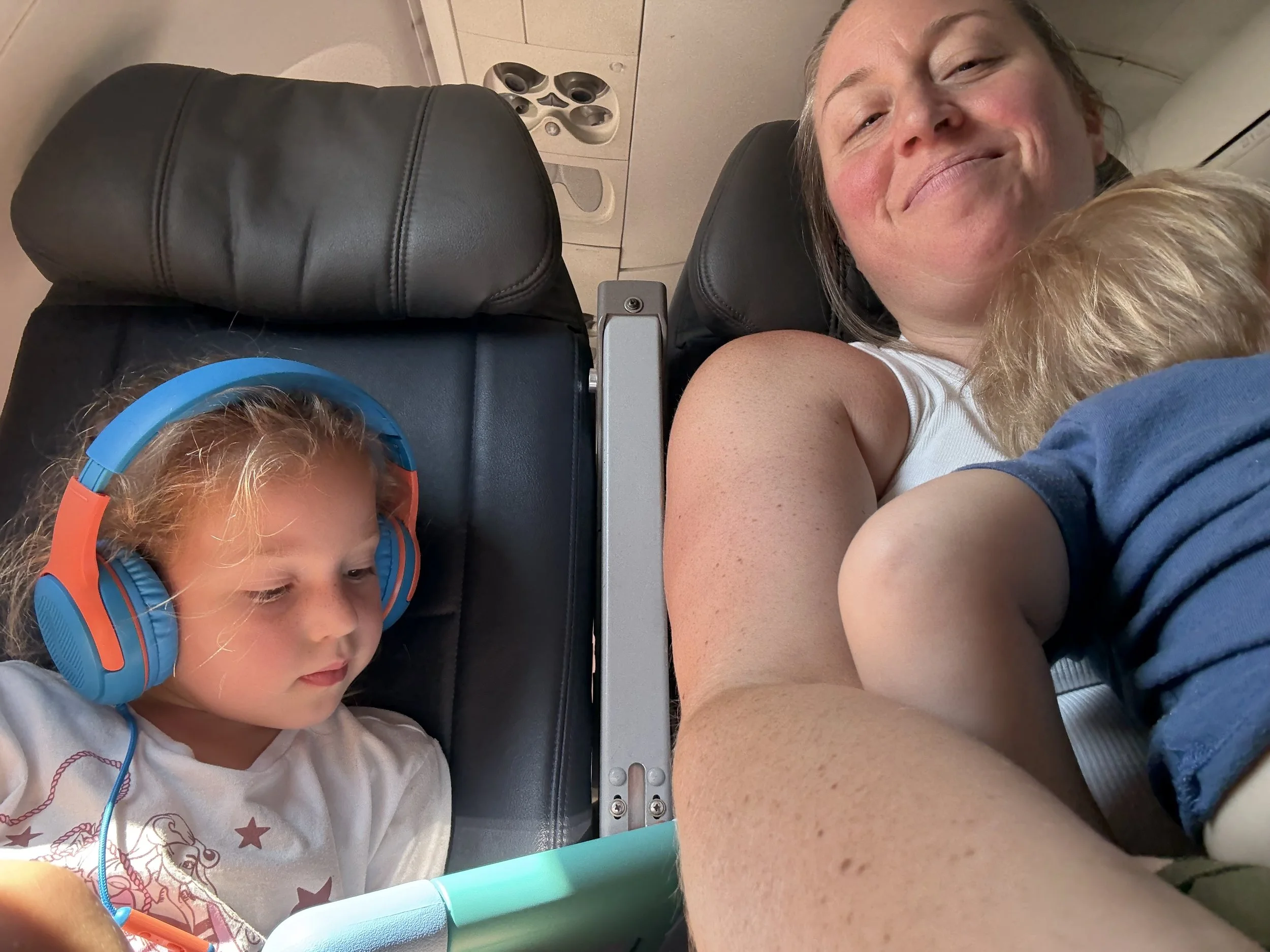
Lap infant saves money but there’s a balance of space and safety
What Gets Flagged at Security
A few things to expect at TSA so they don't catch you off guard:
Baby wipes — our bag gets stopped for these every single time.
Formula and breast milk — agents will likely need to test/wipe the container. (Know your rights around traveling with breast milk and pumps before you go — it's worth a quick look at the TSA's official guidance.)
Any travel-size liquids — double check they meet your airline's volume requirements, or they'll be taken.
Liquid snack pouches — think applesauce packs and yogurt pouches
Any less-common kid item that might just look unfamiliar to an agent.
None of this means you did something wrong. It just means: don't panic when your bag gets pulled.
Car Seats & Strollers: What Works for Us
This is the question I get almost as often as "how do you do it". So let's talk gear.
Confession: I have never traveled with a car seat. There, I said it. I don't recommend checking one, because they get tossed around under the plane and can come back dirty, torn, or straight-up broken. Yes, that means we can't just Uber straight from the airport to our destination, but with kids, we're typically renting a car anyway, and I reserve car seats right along with it.
We also haven't had our kids sit in a car seat on the plane. I know, I know. It's safer, technically. But I like living on the wild side, and honestly, my kids have always been harder to wrestle into a car seat than the fight was worth for a couple of hours in the air. With infants, we've flown with them on our lap (if you want the full rundown on flying with a lap infant, message me, I’ve got tips).
Once they turn 2, though, they can no longer fly on your lap, and you're required to buy them their own seat. The bad news: it's their own real seat, so they need to wear a seatbelt and act like a mini adult for takeoff and landing. The better news: you've now also got an extra seat for them to bounce around in, climb over, and use as a launching pad onto you for the rest of the flight.
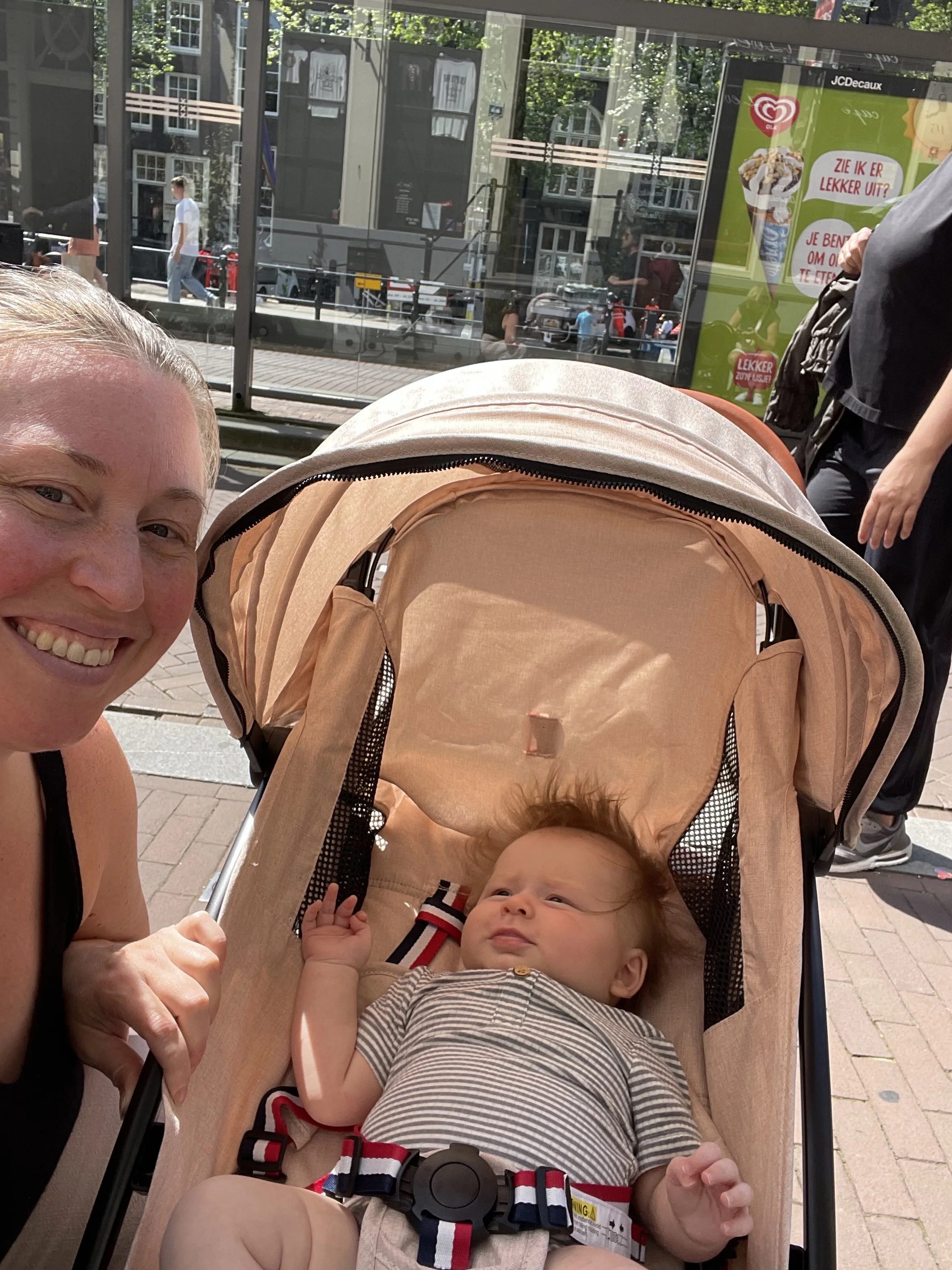
As for strollers, we got smart after our second kid and bought a cheap travel stroller, and it has been on more flights in the last two years than most adults I know. It folds one-handed and weighs less than my bags. It fits in the overhead bin on international flights; for domestic, we just gate-check it. It cost us about $100, and our mentality from day one has been: if it survives even a couple of trips, it's already paid for itself. Every single time we pack it back up, we're pleasantly surprised it's still alive — definitely no longer thriving, but that's on us, given the lack of care it receives. With two kids, having one lightweight, easy-to-collapse stroller has been an absolute game changer. There's always one butt strapped into that seat, which means at any given moment, we're only chasing one loose kid instead of two.
Talk to Your Kids Before You Fly
One of the most helpful things we do before every single flight is simply talk about everything that's going to happen. We start this about a week before, woven into normal parts of our day.
For our 2-year-old, that's building excitement around the small stuff: the shuttle bus from parking to the terminal (it's a five-minute ride, but he looks forward to it now, so what used to be a stressful transition has become a fun one). We talk about what the flight attendants will bring us in the air, all the snacks, juice, water.
Our 6-year-old gets involved too. She helps decide what books and snacks she wants for the flight. We also talk through airplane etiquette out loud, almost like we're "reminding each other" so she absorbs it without it feeling like a lecture: when the seatbelt sign is on, the pilot needs us to stay buckled for safety. If we need to go potty, we tell mom or dad right away. We're going to be excited, but we use indoor voices on the plane because people around us might be sleeping.
We also talk openly about airport safety before we ever get there. Staying close to mom and dad, what moving walkways and escalators are and how they work, keeping "listening ears" on for gate announcements. By the time we're actually in the airport, none of this is new information, it's just a normal conversation we've already had, which makes it so much easier to gently remind them in the moment instead of correcting them with new info.
Travel Day Tips We Live By
A few habits that make travel days smoother, plain and simple:
For domestic flights with no checked bags, we arrive about 1.5–2 hours early. Much earlier, and you'll be pulling your hair out before boarding even starts.
Once you've found your gate, scope out a quieter neighboring gate to use as "home base" until boarding. This gives the kids a little room to move without you having to watch a crowded gate area.
If you want airport food, send one parent to grab it and bring it back to home base. The less you have to pack everyone and everything up to move around, the better.
When a delay or gate change hits, take a breath and focus on what you can actually control.
Be kind to airport staff and flight attendants. They can make or break your and your kids' experience.
If it's your kid's first flight, tell the flight attendant as you board. It's a small thing, but it's often met with something special – wing pins, a card, sometimes even a quick peek into the cockpit.
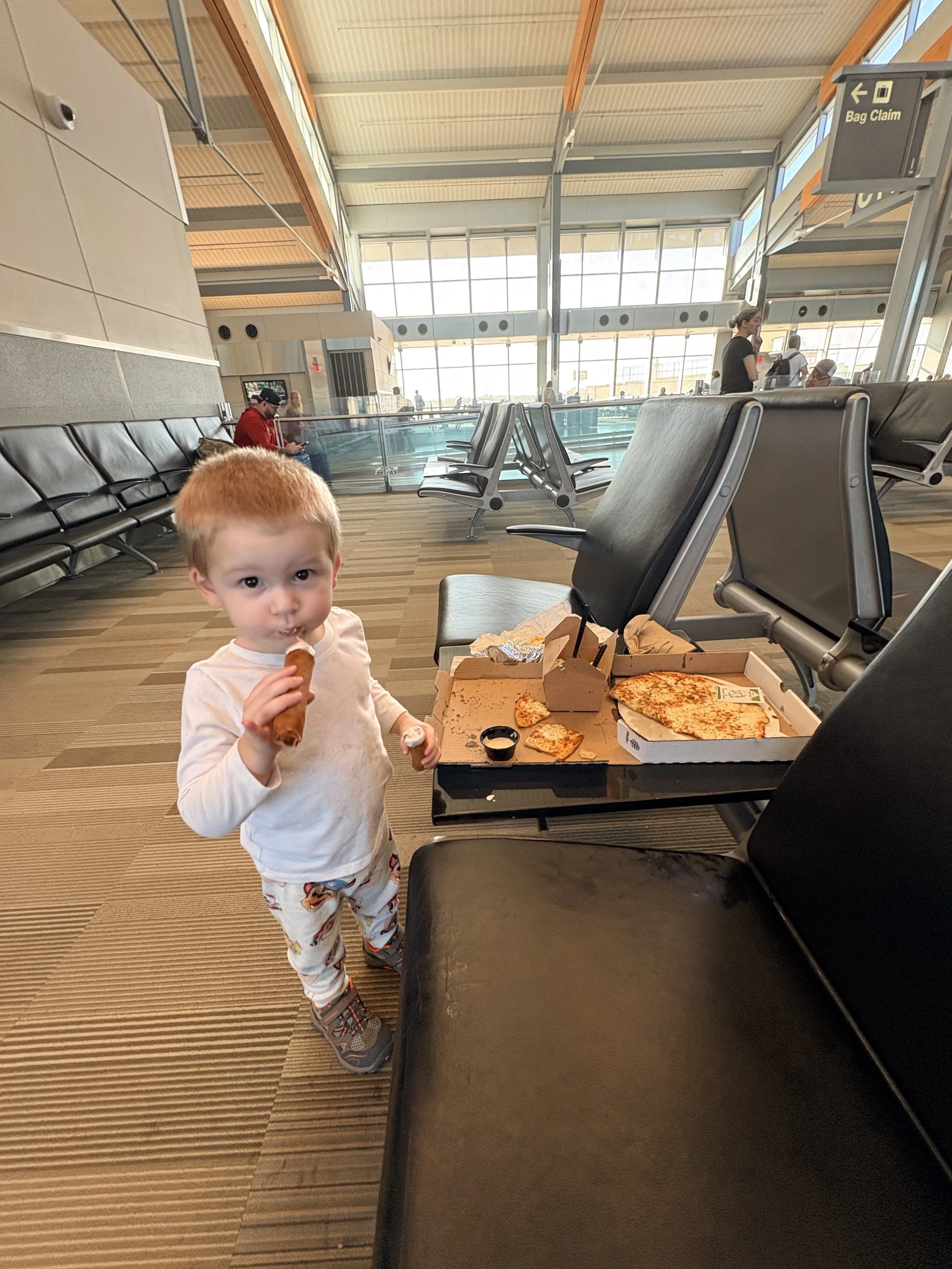
Avoiding crowds at empty gates for dinner time
Make the Journey Part of the Fun
Some of our best flights have had nothing to do with what's packed in the bags and everything to do with how we frame the actual journey. Play I-spy. Wave at the planes landing and taking off while you wait at the gate. Count how many different colors of suitcases people around you have. Once you're in the air, let your kid pick out shapes in the clouds from the window seat, or make up a silly story together about where the other passengers on the plane might be headed. None of it costs anything, none of it takes up space in a bag, and it turns "we have to get through this flight" into "we get to do this together." That reframe is honestly half the battle.
Traveling with little ones is never going to be effortless. Anyone who tells you otherwise is either lying or has very different kids than mine. But it can absolutely be doable, and even fun, once you stop bracing for perfection and start planning for reality.
If you're staring down a family trip and would rather hand off the planning stress to someone who's very much in the trenches with you, that's exactly what I'm here for. I'd love to help you put together a trip that actually works for your family, handling the logistics and extras you might not even know you’ll need. Let's get you and your kids out into the world.
